Label/Mailorder in Kent Ohio United States established 2000
————————————
Andreas Fellinger
freiStil
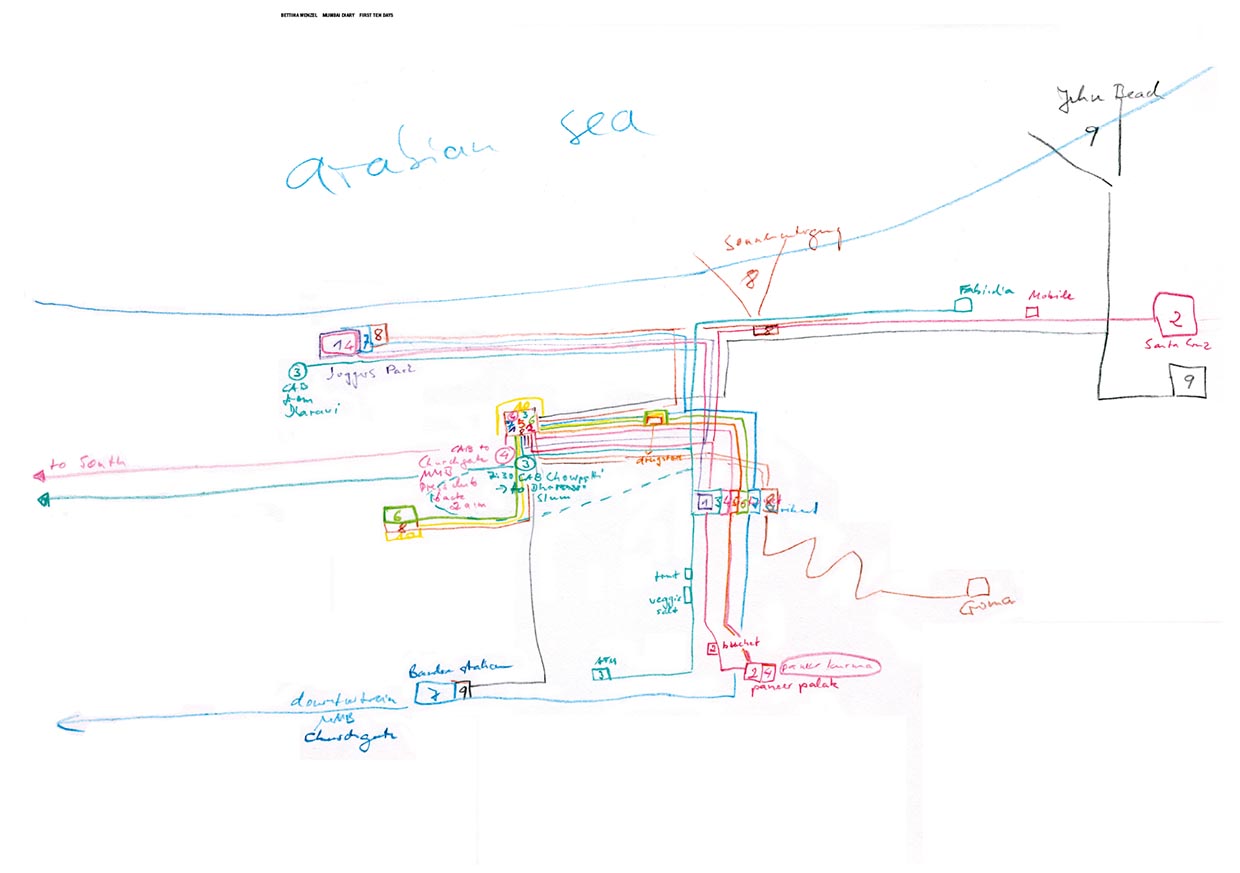
„Mumbai ist wie zwei Pole eines Magneten: anziehend und abstoßend zugleich“, erinnert sich die Kölner Vokalistin Bettina Wenzel an ihr halbes Jahr in der indischen 18-Millionen-Einwohner-Stadt, genauer in deren Stadtviertel Bandra. Die Kunststiftung Nordrhein-Westfalen und das Goethe-Institut hatten ihr dieses Arbeitsstipendium ermöglicht. Wenzel revanchiert sich für die Einladung mit einem akustischen Tagebuch. Einem Tagebuch, das allerdings nicht linear erzählt, sondern punktuelle Impressionen festhält, sie mit Fantasie dokumentiert, interpretiert und für vokale Assoziationen verwendet. So finden sich neben ihrer Stimmkunst diverse field recordings, von Straßenszenen, öffentlich gespielter Musik und verschiedenen Klangobjekten. Darüber und dazwischen regiert Wenzels einfühlsame, in aller Einfühlsamkeit prägnante Stimme, die sie ab und zu, aber ohne technische Hilfsmittel, ins Unkenntliche moduliert. Tja, und dann finden wir endliche wieder einmal ein Poster einer CD beigelegt, darauf sehen wir eine gezeichnete Skizze der ersten zehn Tage von Bettina Wenzel in Mumbai.
————————————
Aurelio Cianciotta
Neural
of city traffic. Glimpses of a background with exotic music and citations that emerge alienated from their original context reassemble during atonal passages into extended audio emergencies that include metallic sounds, squeaks, gloomy lullabies and sighs. In „Mumbai Diary“ Bettina Wenzel shares with us an intimate universe, a deliberately fragmented and „gibberish“ narration, characterized by a precise geographical connotation, yet still very personal in the eccentricity of musical forms, intentionally ever-changing and sharpened by the possibility of intrusive meanings that always lurk in the delicate interweaving of stylistic connections. Here are iterations that, despite the many recordings made by the artist, have been largely rebuilt in a home setting – Wenzel’s Indian apartment – as part of the search for a sound quality that in the „road catches“ was merely hinted at. Finally we arrive at an intense sound, with nasal voices in harmony with the equally loud and evocative sounds of the eastern metropolis.
endliche wieder einmal ein Poster einer CD beigelegt, darauf sehen wir eine gezeichnete Skizze der ersten zehn Tage von Bettina Wenzel in Mumbai.
————————————
Loop/Chile
www.loop.cl
————————————
Interview Bettina Wenzel | By Guillermo Escudero
LOOP
German vocal artist, composer and improviser sound artist Bettina Wenzel works in different fields like performances combining voice, video and objects. Furthermore vocal compositions only and as improviser and performer she has been through out Europe, USA, and India. On “Mumbai Diary”, her most recent audio work she has recorded a wide range of sounds that the city give: car engines, people talking and screaming, birds, religious chants, objects and of top of this Wenzel added her vocals works expressed by the different emotions she felt in relation with the sounds. A very deep work indeed.
www.gruenrekorder.de and www.wenzelvoice.de
Which relation has your vocals with the street sounds on „Mumbai Diary“?
“It’s not so easy to give an answer, because the relation is created in a very intuitive way. By listening to my Mumbai field recordings as manifestations of the outside world, I listen in same time to the sounds of my inside world. Mumbai city was basically an unknown surrounding for me, where I didn’t grow up or where I don’t live normally. That makes that the sounds I hear are sometimes remaining without cognitive explanation. For example the bird sound you can hear in ‘Mumbai Diary’ is the sound of a bird I’ve never seen. But for me, the sounds that bird makes are more interesting than to know how it looks like. Because it confronts me to a new and fascinating world that makes me act and react. My vocal sounds are a kind of answer to what I hear. All vocal sounds are based on the emotions that I have at the moment I’m listening to the street sounds. They are recorded separately from the field recordings and consequently based on remembered emotions.”
Which was the criterion to choose the street sounds during your stay in Mumbai?
“I enjoy myself to be in a surrounding, where I can hear very spare and small sounds, getting my ears very sharpened, especially listening to noises coming from the street when I find myself inside a building. i made a lot of recordings of the city from inside my apartment, but those recording where not usable for the CD because they where to distant to represent the listening quality I had in reality. So I decided to produce some typical sounds inside of the apartment itself. I smashed empty plastic bottles – as I had to do every day – and recorded the sound, then added the vocal sound. Besides listening to small sounds I like to be overwhelmed by a big street sounds with high intensity as well. In Mumbai I could find and record those full and complex sounds during religious street feasts. Corresponding to this intense sound, I choose during the voice recording session a powerful nasal vocal sound and felt virtually being part of this joyful noise making street. In Mumbai diary you’ll find very in time and small sounds and very powerful sounds as well. The criterion was to give the most diversity of sounds; this diversity is corresponding diversity of the city.”
How the different places where you have been influenced your vocal works/performances?
“Everywhere I go, I go there with my body and my emotions. All sounds I listen to, provoke a reaction in my body and my mind. This reaction is in my case transformed into vocal sounds. most of the places I went in Mumbai did trigger those reactions in an very intense way. So I recorded the sounds of those places by remembering my emotion later on. In a next step, I recorded the voice in a studio by choosing how to respond to the different sounds from Mumbai places and their special characters. During my 6-month residency in Mumbai, I also developed a vocal performance piece using four fans called ‘black_fan_quartett.’ in many places -almost everywhere- even in trains; I could listen to sounds of fans. Their shapes. Age and speed where influencing the sound in many ways and inspired me using this diversity for a composition.”
Which is the vocal work challenge the most?
“I think, to get another idea of beauty. For me, vocal sounds have a special beauty- even the ‘broken’ ones. But only if they are related to an emotion and if that emotional power is then transformed into alternative vocal expression. The most challenging is to continue to search for this quality of voice beyond singing techniques or purely traditional criterions.” Guillermo Escudero / January 2011
————————————
Brian Olewnick
Just outside
In which Wenzel deploys site recordings from Mumbai which are perfectly enjoyable, ranging from street sounds to musical ceremonies, but insists on threading them with her vocals which, generally speaking, are somewhere in Shelley Hirsch territory, admittedly not a destination I find very appealing. She’s good at what she does, her vocal pyrotechnics impressive I guess (sometimes sounding eerily like a shenai) but the question lingers: why? Why place oneself so prominently into the mix? What have you really added? I could imagine something more along the lines of Pisaro’s „Transparent City“ where the composer’s contributions are deferential to the recorded sounds, in this case, Wenzel’s vocals being just another element in the mix. But here, it’s far too much her, and what she does isn’t all that interesting. Where’s Ami Yoshida when you need her?
————————————
Oreshkin Sergey
maeror3.livejournal
Кто-то привозит из путешествий множество фотографий, чтобы потом рассматривать их и вспоминать о дивных (впрочем, тут кому как повезло) странствиях. Кто-то привозит мысли и впечатления, чтобы доверить их бумаге или клавиатуре компьютера. Немногие люди, воспринимающие окружающий мир скорее органами слуха, нежели зрения, привозят многочасовые аудиозаписи, сделанные ими на протяжении всего маршрута, чтобы потом, прослушивая их снова и снова, воссоздавать звуковую атмосферу далеких мест у себя дома.
Известная авангардными перфомансами немка Беттина Вензель записала в Индийском Мумбае шум заполненных суетливыми людьми городских улочек, тишину деревенского вечера, нарушаемую лишь шорохом листвы, голоса из хрипящих радиоприемников, пение уличных музыкантов и популярные мелодии индийского кино. Многим хватило бы и этого, чтобы создать еще один из многочисленных коллажей на тему «конкретной музыки», но немка пошла другим путем и решила стать частью зафиксированного ею мира. Для этого поверх оригинальных записей Вензель наложила звуковую дорожку со своим голосом, пытаясь попасть в настроение каждого конкретного момента и вписаться в его ауру, так сказать. К сожалению, лично мною этот оригинальный, чего уж там, эксперимент, помноженный на скрип и умеренный ритм непонятного и не обнаруженного на просторах Интернета инструмента или предмета с названием «Akappaikinnari», остался непонятым. Дело в том, что Беттина большую часть времени довольно неприятно изображает экстатический припадок, то склоняя на все лады какую-нибудь букву или звук, то старается имитировать традиционное пение (подражая актрисам из кинофильмов) и «голосовую» перкуссию, но больше всего это похоже на мелкие кусочки разорванной пленки с записью голоса «а капелла», которые потом склеили в произвольном порядке. Заикания, смешки, нотки сумасшествия, чириканье на птичьем языке, перепады настроения – «voice art», в отличие от оригинальных «полевых» записей по душе мне не пришелся. Хотя идея интересна – интеграция в оригинальную атмосферу, взаимодействие с ней и расширение пространства, в котором обитают повседневные звуки, новый взгляд на другую культуру, наконец. Можно, отбросив субъективность, признать это интересным.
link
————————————
Frans de Waard
VITAL WEEKLY
[…] The third release using voice is by Bettina Wenzel. She was in Mumbai where she did some field recordings and played some sounds. These are a quite alright, but it eludes me why she wanted to add her abstract use of the voice to these, other than perhaps that just the field recordings and played sounds aren’t the strongest in the world. But the addition of voice however adds an odd ball to these recordings, and doesn’t say much about Mumbai itself. Or maybe after a double CD and a DVD I am just a bit tired of abstract long voice material. Even then it would probably not be thumbs up, but not really down either. […]